Month: March 2016

Candidate Comments: Julie Morgan – Labour

Guest post by Julie Morgan

Julie Morgan is the Labour Party’s constituency candidate for Cardiff North.

The views expressed in this article are those of the author and do not necessarily represent the views of, and should not be attributed to, My Cardiff North.

Julie Morgan

I’m Julie Morgan and I’ve been working hard for constituents in Cardiff North as their Assembly Member since 2011. It’s an area that I care deeply about and I was also MP for the constituency from 1997-2010.

In my time as Assembly Member I’ve worked flat out for my constituents, running a fully-staffed office open five days a week in Whitchurch and holding surgeries twice-weekly. My office has dealt with more than 3,000 cases since I was elected in 2011 and I will always go the extra mile to help people. I’ve chaired seven Cross-Party Groups at the Assembly – including on children, cancer and nursing and midwifery – and served on three committees: Environment, Public Accounts and Finance.

I’ve attended thousands of events and supported local causes, charities and schools. Just in the last 12 months I’ve organised events myself including my 15th Macmillan Coffee Morning (more than £10,000 raised over the years), a Velindre Coffee Morning, an Older People’s Event, an Environment Event, a green belt protest, a music and movement class for older people and a food waste event.

I’m standing for re-election again in 2016 because there’s still work to be done! On health I’ve lobbied long and hard for the £200m new Cancer Centre at Velindre which is now set to become a reality but I’m still lobbying for a Maggie’s – a drop-in support centre for cancer patients – to be built in the grounds of Velindre and hoping for good news on this soon.

I’ve worked for many years with a group of patients affected by the NHS contaminated blood scandal who contracted the disease Hepatitis C as a result. Last autumn we had excellent news when the Welsh Government agreed to fund a new drug which has already cured many of Hepatitis C but I’m still lobbying both the Welsh Government and Westminster on behalf of this group over what I fear will be a watered-down system of payments for them (this is currently under review by the Conservative government in London).

JulieOn the Environment I’ve lobbied for years for a green belt for the land north of the M4 which will benefit all Cardiff North residents and would secure this precious land for their children and grandchildren. I’ve submitted two major petitions on this – the most recent in 2015 – and we have at last succeeded in persuading the planners to give the area some protection, although in the form of a green ‘wedge’ not green belt. This means it will be protected for the next 10 years but the campaign for full, lasting protection continues.

I’ve been involved with the Reservoir Action Group in Lisvane and Llanishen for the long 15-year fight to stop the redevelopment of the reservoirs – and at last there has been good news on this. Now the reservoirs will revert to the ownership of Dwr Cymru Welsh Water and it has promised to re-open them for the enjoyment of the public. There’s still work to be done on this to make sure we can get sailing, fishing, walking and nature conservation back there.

One of my new campaigns I’ll be launching will be to ensure there is enough childcare provision in Cardiff North to enable people to take up Welsh Labour’s promise of 30 free hours of childcare a week for three and four-year-olds of working parents. Two nurseries have closed in the constituency while I’ve been AM (despite organising protests) so I feel this is a very important issue.

I’ll also be continuing my campaign on the control of dangerous dogs – dog microchipping comes in this April which is a step in the right direction but there’s more to be done – and for a ban on the use of snares which can trap wild animals and domestic pets especially cats.

Lastly one of my newest campaigns is on the subject of food waste. I held a debate in the Assembly on this which sparked a lot of interest and I will be campaigning for the supermarkets to be required by law to partner with charities to give away unwanted food, as new legislation in France has recently required them to do there.

I hope you’ll support me in my fight to win the Cardiff North constituency once again this year so I can carry on serving constituents and charities as I’ve done for a large part of my working life.

By Julie Morgan

twitter.com/JulieMorganLAB

Candidate Comments: Jayne Cowan – Conservatives

Guest post by Jayne Cowan

Jayne Cowan is the Conservative Party’s constituency candidate for Cardiff North.

The views expressed in this article are those of the author and do not necessarily represent the views of, and should not be attributed to, My Cardiff North.

Jayne Cowan

“My Cardiff North” – that’s exactly how I see the area in which I have lived all my life. I was born in Cardiff North, grew up in Cardiff North, went to school here, worked here and remain living here with my husband and both our families. I want the people of Cardiff North – us – to enjoy the best possible quality of life and I will work hard to achieve that ambition.
I have been privileged to serve as a councillor for Rhiwbina for 17 years. Throughout that time I have stood up and spoken up for local people. I have campaigned to preserve vital local facilities which local people value. I stood up against the Labour party when it threatened to close our libraries and other services forcing them into a humiliating climb down. I struggled to ensure that Labour honoured its commitment to preserve a green belt around Cardiff as part of Cardiff’s Local Development Plan only to witness Labour’s last minute retreat when their political masters in Cardiff Bay decided our opinion didn’t matter.

I believe that my experience and dedication and my record as a fighter for the people I serve will prove invaluable should I be elected to the National Assembly in May.

But this election isn’t only about Cardiff North. And hard work alone will not be enough. What Cardiff North needs – what Wales needs – is a change of Government. We need to be rid of this worn out Labour Government in Cardiff Bay that has been in power for 17 years and which has taken Wales backwards.

In 1997, Wales was 35th in the league tables of education standards – and that was totally unacceptable. Well today, thanks to a backward looking Labour Government, Wales stands 36th in science, 41st in reading and 43rd in maths. For the sake of our children we need to vote for change on May 5th.

Under Labour, Wales has the worst rate of economic inactivity of any region in the UK.

JayneOur Welsh Health Service is blessed with an army of hard working, committed and dedicated doctors, nurses and other healthcare professionals supported by magnificent support staff who literally perform miracles every day. It’s a pity the same can’t be said of the politicians in Carwyn Jones’s failing Welsh Labour Government.

Welsh Labour politicians have led our health service from one crisis to another. Unlike in England where the Coalition government protected health spending, Welsh Labour starved our health service of the funding it needed.

In Wales General Practice is in crisis. Doctors are “handing in the keys” leaving thousands of people without a GP. Health Boards are in special measures citing failing leadership as the reason for failure. All this needs to change and a Welsh Conservative Government will make the changes Welsh health workers need.

In Cardiff North we have two centres of healthcare excellence – the University Hospital of Wales and the Velindre Cancer Hospital. Both are crying out for the type of investment that the Conservative planned £100 million pound Health Transformation Fund will deliver.

The sad truth is that this Labour Government has run out of ideas, run out of steam, and has no meaningful plan to turn things around. Wales has a government that after 17 years in power presides, over the poorest part of the UK; over a failing health service; over a failing education service.

It’s a government which sells land worth £36 million for just £20 million and which pays £52 million for an airport worth £20 million. It really does beggar belief. If it was a local authority it would be in special measures.

On May 5th the people of “My Cardiff North” can help change all that by voting for me as their local Assembly Member.

By Jayne Cowan

twitter.com/JayneCowan

Candidate Comments: Chris von Ruhland – Green Party

Guest post by Chris von Ruhland

Chris von Ruhland is the Green Party’s constituency candidate for Cardiff North and regional list candidate for South Wales Central.

The views expressed in this article are those of the author and do not necessarily represent the views of, and should not be attributed to, My Cardiff North.

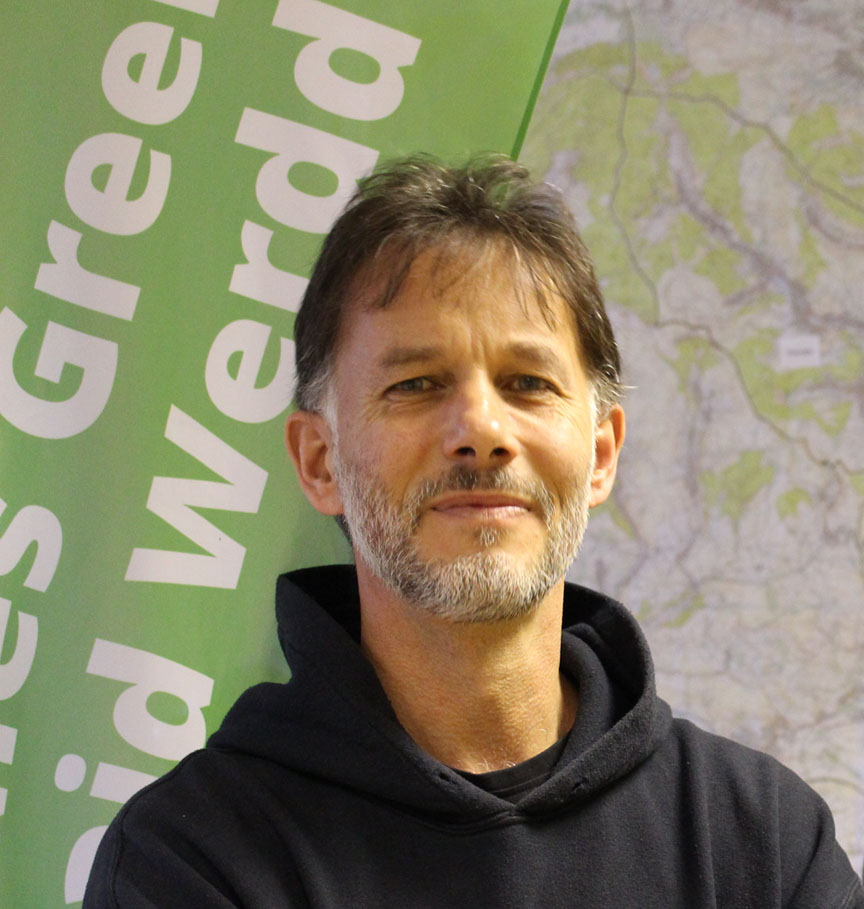
Photo of Chris von Ruhland

When I first visited Cardiff, over 35 years ago, what first impressed me was Bute Park and Sophia Gardens; magnificent public green spaces right in the middle of the city and flanking its major river. This contrasted sharply with the city from which I had come, namely London. I was informed that Cardiff had a greater proportion of green spaces than any other European city.

When I moved to Cardiff a few years later to study, and finally to live and work, I had many opportunities to explore it further. What struck me, in particular, was that the edges of the city, to the north and to the west at least, were clearly visible from many parts of Cardiff. I had lived for the past 2 years in southern Plymouth and, standing on the Hoe and looking north, all that I could see was a hillside covered in houses, like a huge wave of brick and stone. This contrasted sharply with the view that I now beheld. Cardiff was clearly a very special city.

The reason that the land to the north of the M4 has remained undeveloped is, primarily, topography; there are flatter places to build. Another reason is that the M4 motorway forms a barrier, albeit an unnatural one, to Cardiff’s northern expansion. There has also been considerable reluctance on the part of the city council, over many years and political hues, to release the land for development.

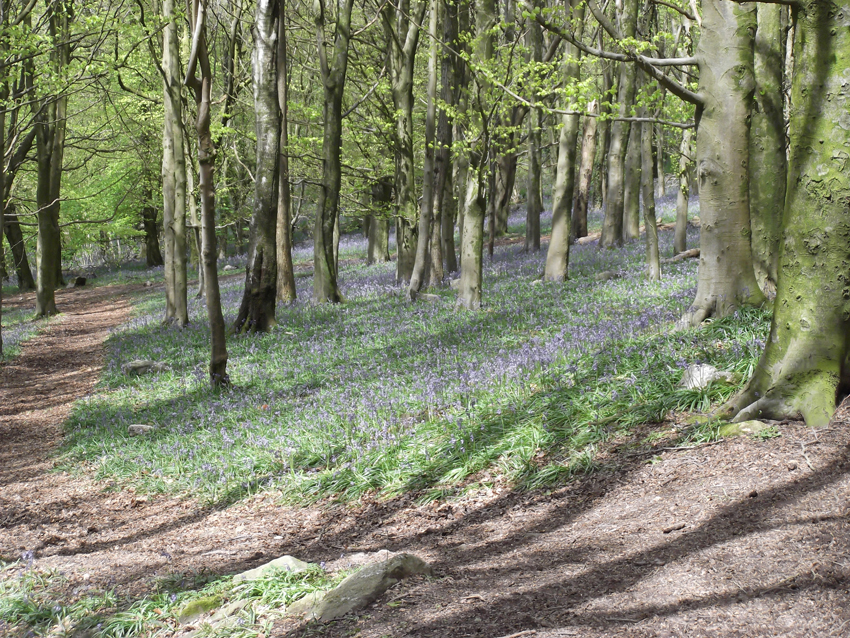
Bluebells on the Wenallt

While this area has been designated a green wedge under the local development plan, it only confers protection until 2026. Residents, councillors, local MPs and AMs are unanimous in their support for a Green Belt, that would protect this area for future generations, yet Cardiff Council failed to convince the planning inspectors.

Chris von Ruhland profile graphicThe inspectors were subject to the requirements of Planning Policy Wales, which has existed since 2002 and is now in its 8th edition. It is surprising, therefore, that any objections to the green belt proposal were not predicted and adequately addressed, particularly when the two institutions are a stone’s throw apart. Don’t people talk to one another?

The problem is that there appears to be no long term vision of how Wales in general, and Cardiff in particular will look in several decades’ time. Without this, there can be no meaningful short term planning; it is purely a reaction to existing circumstances. Cities, in general, become worse places as they get bigger; people must travel further for work, leisure and shopping, traffic congestion becomes a daily grind and air pollution becomes a serious problem. Cardiff seems to be on this trajectory, having become a victim of its own success. The demand for housing has never been greater and large areas of what remains of the green spaces that surround the city have been earmarked for development, with little apparent thought given to the necessary infrastructure requirements.

Such a laissez faire attitude will not protect the remaining green spaces and Cardiff is likely to expand inexorably, merging with Caerphilly to the north and Barry to the west; indeed, westward expansion into the Vale of Glamorgan was proposed many years ago to bring Cardiff airport into the city boundary. Fortunately, this madcap scheme was shelved.

In the city, we are constantly subjected to the sharp angles of buildings and, increasingly, great swathes of bland grey concrete or cladding; little wonder that some take it upon themselves to decorate these surfaces with graffiti/ urban art, depending upon your viewpoint. The natural and rural environment provide a necessary relief from these assaults on our senses. What is important, I think, is not just having open countryside so close to the city, but being able to see it, to know it is there. It defines its boundary. To lose this would be a travesty.

If we are to protect what we value, then we need to plan long-term, and much longer term than we have become  used to. Greens do this as a matter of course, which is why their voices are so desperately needed in the Senedd. What should be a place of vibrant and diverse political debate has become rather staid, with one party permanently in power. Little wonder that less has been achieved than we might expect. We need to shake up the Senedd.

By Chris von Ruhland

twitter.com/chrisvonruhland

Introducing Candidate Comments

Candidate comments banner graphic

In order to help you decide who to vote for in the upcoming Assembly Election, we’ve asked all the constituency candidates to write for us.

The candidates were asked to submit 500 – 750 words about any subject of their choice.

Three candidates sent us articles for the first series and six for the second. We’ll have a final series just before polling day.

Series 1

Series 2

Series 3

coming soon

In the coming months we’re going to host a tweet chat where you’ll get the chance to have a live discussion with the candidates. Subscribe to this blog for updates.

My Daily Cardiff North – 10 Mar 2016

My Daily Cardiff North logo

https://twitter.com/oggybloggyogwr/status/707988539678523393

#Wales2016 Gets Under Way


Senedd 1

In case you hadn’t noticed, the 2016 National Assembly for Wales election is well under way. I’m keeping up to date with news and adding information to the candidates page as I come across it.

Candidates graphic

The Assembly has published a great website to explain what they do and what we’re voting for. They’ve also produced some handy videos.


For those of you who like to keep up to date on Twitter, the official hashtags are #Wales2016 and #Cymru2016.

Cardiff North has got four constituency candidates so far. I’ve offered them all the opportunity to write a column for this blog in the run up to the election, which I’m happy to report they’ve all accepted. New candidates will, of course, also be invited.

If you’d like to write about where you live – just like Simon Braybrook did – please get in touch.

Image credit – Alex Martin

How the Welsh voting system could secure nine Assembly seats for Ukip

The Conversation logo

Exterior of The Senedd (National Assembly building)

Jac Larner, Cardiff University

On May 5, voters in Wales will head to the polls to elect the country’s fifth devolved government. This forthcoming National Assembly is set to look dramatically different to all of those preceding it, namely because of the addition of one party – Ukip.

Polls in Wales have shown the party steadily increasing its support, building upon its strong 2015 General Election performance, when Ukip came second to Labour in six of Wales’ constituencies, and third overall in the Welsh popular vote. Indeed, it appears as if nothing is able to stop their march on the Senedd.

Despite a month of media coverage of Welsh Ukip infighting and lack of cohesion, the latest Wales Barometer Poll recorded the party’s highest level of support yet in Wales – 18% at both the constituency and regional level. With the Conservative party at 22% and Plaid Cymru at 19%, there could very well be a three-way struggle for the position of Wales’ second largest party.

For a party that at its peak had just two MPs, both from the South East of England, many outside Wales reacted with shock to the news that Ukip could achieve such significant levels of support in Wales. The Financial Times went so far as to describe Ukip’s position in Wales as “surging”.

However, this characterisation is mistaken. Ukip support in Wales is broadly in line with that of much of England. In the 2015 general election, Ukip received 14.1% of the vote in England – compared to 13.6% in Wales – while in the northeast of England – the region most similar demographically to Wales – Ukip received 16.7% of the popular vote. A YouGov poll on February 4 measured UK-wide Ukip support at 18% –- the same as that recorded in Wales.

The difference is that in Wales, Ukip could realistically convert this support into significant representation in the Assembly. It is less a matter of “surging” support in Wales and more a symptom of an electoral system that could bring them actual power.

The electoral system used in the UK for general elections in effect penalises the sort of broad support that Ukip has (think back to the Liberal Democrats in 2010). In order to win representation at Westminster, it’s necessary to have geographically concentrated support, to win in First Past the Post (FPTP) constituency contests.

For the Welsh Assembly elections, however, a different electoral system is used, one which combines two votes: one FPTP, and one which is a form of proportional representation (PR). This PR section of the vote “penalises” parties that win constituency contests, making it easier for smaller parties to win seats. This system suits Ukip very well, as, unlike Labour, the Conservatives and Plaid Cymru, their broad levels of support aren’t concentrated enough to win constituency seats.

So, while levels of support for Ukip in Wales are not particularly different from anywhere else, the electoral system in Wales is better suited to transform their levels of support into representation.

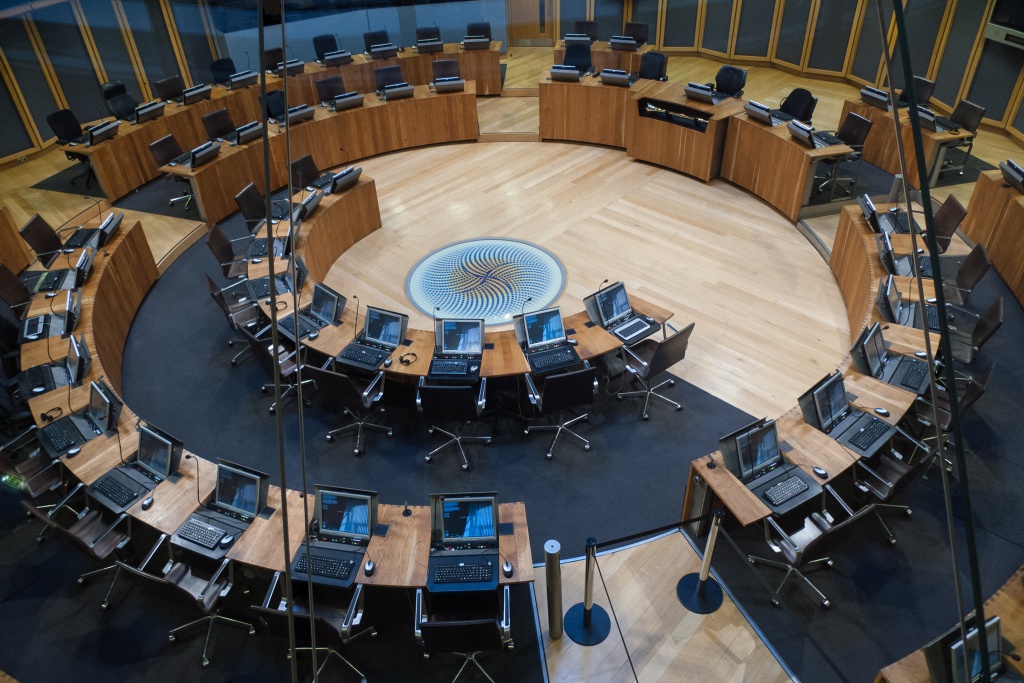
Interior of The Senedd (National Assembly building)

Though Ukip support in Wales may not be surging, it undoubtedly appears to be increasing steadily: Ukip support in the regional list has grown from 13% in a May 2015 Barometer poll to 18% in the most recent.

What is behind this steady increase isn’t entirely clear. One possible explanation is the dramatic increase in media coverage of the impending EU referendum. Ukip has attempted to position itself, with some success, as representing one side of that debate – so much so that a media discussion of the EU is often accompanied by a mention of Ukip.

With the EU referendum now confirmed to take place shortly after the Assembly elections in May, the EU vote is likely to supplant the National Assembly for Wales as the top political news story. As a result, the publicity Ukip receive will get a significant boost. Indeed, the same Barometer poll that measured Ukip’s support at 18%, also showed that 45% of respondents would opt to leave the EU, compared to 37% who would opt to stay. It’s possible that the interplay between these two political events will only increase as both campaigns get closer.

Whether Ukip can turn this support and coverage into seats in the Senedd, however, will likely be a question of turnout. Turnout is historically lower in Assembly elections – just 41.4% in 2011 – so “getting the vote out” is vital for parties to succeed. Plaid Cymru, for example, has historically been successful at this, achieving vote shares an average 10% higher in Assembly elections than general elections. Ukip, is somewhat of an unknown quantity here.

With the EU referendum just seven weeks after the devolved elections, it will be interesting to see what effect – if any – this has with their supporters. Will Ukip supporters have their attention focused on the “big one”, and neglect the Welsh vote? Or will they be galvanised and use the devolved elections as a launchpad for their campaign? How Ukip supporters react, could well decide the makeup of the next National Assembly for Wales.

The Conversation

Jac Larner, PhD researcher, Wales Governance Centre, Cardiff University

This article was originally published on The Conversation. Read the original article.

Image credit – Marc | Glenn Wood